Helen Macdonald
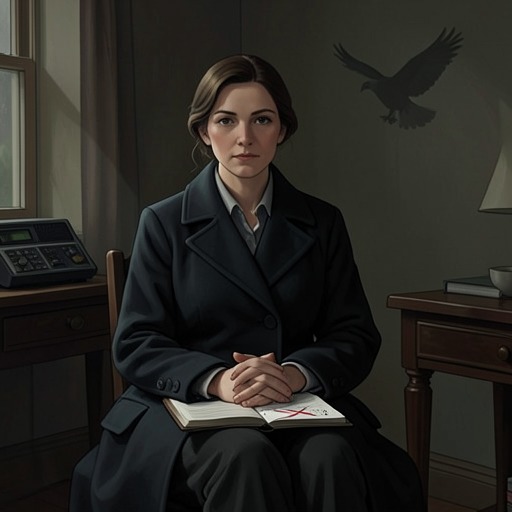
H is for HawkHelen Macdonald is the narrator and central figure of the memoir, whose account links her father’s death to an increasingly consuming relationship with goshawks. The landscape of the Brecklands first draws her out of an unsettled morning and into observation; after bereavement, the same attention becomes more intimate and perilous. Training a hawk offers discipline and contact with another creature, but Macdonald also begins to imagine the bird’s apparent freedom from grief as a condition she herself can enter.
Identity and Landscape
Macdonald’s attachment to the Brecklands is introduced through a place both loved and damaged. Forty-five minutes north-east of Cambridge, the landscape shifts from wet fen to dry sand and combines twisted pines with burned-out cars, shotgun-marked road signs, and United States Air Force bases. Abandoned houses lie within numbered blocks of forestry; grassy tumuli and high fences enclose spaces built for air-delivered nuclear weapons. Tattoo parlours and air-force golf courses belong to the same terrain. In spring, woodlarks and jet engines, gas-guns and aircraft produce a layered soundscape in which the natural and military worlds are difficult to separate.
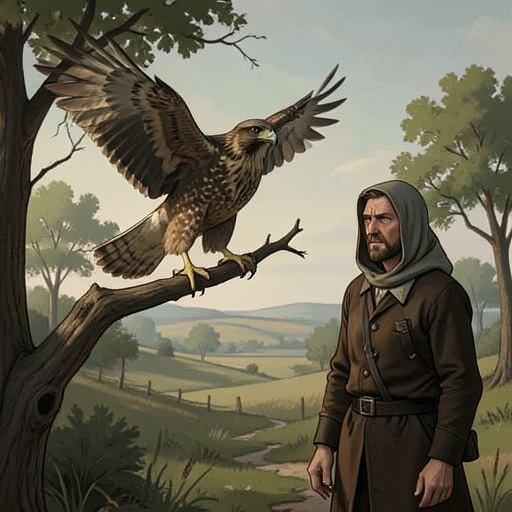
Seven years before the account’s present, Macdonald arrives there on an unplanned early-spring journey. At five in the morning she is awake beneath a square of streetlight, feeling exhausted and mentally battered. She pulls on jeans, boots, and a jumper, burns her mouth on coffee, and only works out where she is going once her old Volkswagen is already on the A14. The destination resolves into a purpose: the forest, and the hope of seeing goshawks. Her movement from bedroom to road turns diffuse distress into a specific act of looking.
That search also rests on an awareness of how rarely a goshawk is seen in the act of hunting. Macdonald describes finding the remnants of small birds on patio stones: a leg with its foot clenched by contracted sinews, or part of a house-sparrow’s beak with a few feathers still attached. Such traces make predation legible without making the predator present. Her interest is therefore shaped not only by the spectacle of a hawk but by the difficulty of witnessing it at all.
Bereavement and Disorientation
The death of Macdonald’s father enters through an ordinary interruption. She is about to leave, keys in hand, when a call from her mother begins with news of a telephone call from St Thomas’ Hospital. A pause and a change in her mother’s voice tell Macdonald what has happened before her mother confirms that her father is dead. Her legs give way, and she ends up seated on the carpet with the phone pressed to her ear.
As her mother explains that nothing could be done for his heart, Macdonald fixes her attention on a small ball of reindeer moss on a bookshelf. Its hard grey stems, sharp dusty tips, and spaces of air offer a precise object to look at while the family’s shared world seems to have already disappeared. Her mother says she need not drive back that night because it is late and the journey is long. Macdonald recognizes the advice as inadequate to the moment: neither of them knows what should be done, and her brother is also caught in the same rupture.
The immediate aftermath does not produce a composed ritual of grief. Christina, Macdonald’s Australian philosopher friend, is present on the sofa when the call comes. Macdonald tells her what happened and insists that they still go to the restaurant because a table has been booked. They go, order, and leave the food uneaten. The waiter notices that something is wrong and is upset by what he sees. The persistence of the reservation and meal makes the ordinary schedule continue around a loss that has made ordinary life feel unreal.
Choosing a Goshawk
Later, Macdonald describes the surrounding world becoming strange even while she continues to perform daily tasks. The light in her house seems deep and livid; familiar objects appear dark and still, and the house feels like a place at the bottom of the sea. She hears her own breathing and startles at it, while an unseen presence seems to separate her from the things around her. At night she dreams of a hawk slipping through wet air, and wants to follow it. The dream gives direction to a feeling of estrangement that daytime routine has not resolved.
From her rain-lit study, Macdonald telephones friends and writes emails until she finds a breeder in Northern Ireland with one young goshawk left from that year’s brood. The bird is ten weeks old, half Czech, one-quarter Finnish, and one-quarter German; she is small for a goshawk. Macdonald arranges to drive to Scotland to collect her. Smallness is the only preference she recalls consciously choosing. She does not experience the selection as a decision among birds: in her account, the hawk has caught her rather than the other way around. That reversal presents the new relationship as a force already under way, not simply a project she has calmly elected to begin.
Watching and Transformation
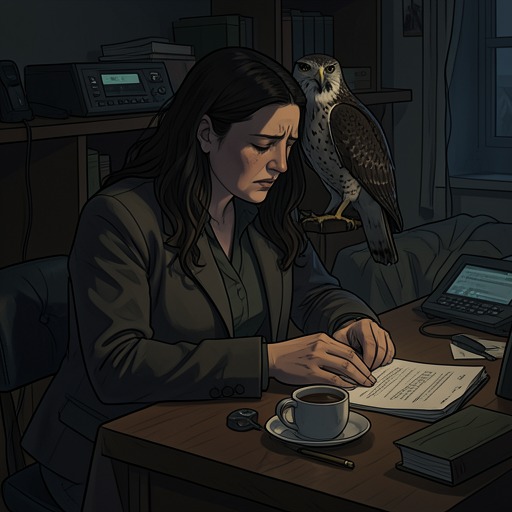
Macdonald’s first response to the young hawk’s sleep reveals how bereavement alters her reading of events. The bird is tired and dozes on the glove, but Macdonald worries that she is sick because hawks sleep when ill. Her own sleep is also alarming to her. A dream of a burned-out house, its blackened frame collapsing, ends with both woman and hawk waking in apprehension. Macdonald clings to the sight of the bird to recover a sense of the world without ash. The imagined danger belongs less to the hawk’s condition than to Macdonald’s uncertainty about her own.
She then identifies the difference between knowing the procedures of hawk training and being the person who must carry them out. She has flown many hawks and recognizes each step, yet feels that the self performing those familiar tasks has changed. She describes herself as orphaned, suggestible, and in ruins, with some part of her trying to rebuild itself by taking the hawk as its model. The qualities she attributes to the bird—solitude, self-possession, freedom from grief, and numbness to human hurt—are precisely what she longs for. Her declaration that she is turning into a hawk names an imaginative transformation rather than a physical one.
That transformation develops through sustained attention to the bird’s posture and feathers. Macdonald learns to distinguish fear from ease in the way feathers lie against the body, and becomes alert to subtler signs: a contraction around the beak or a narrowing of the eyes, and an expression she reads as sleepy. Training consequently involves more than commands or repeated handling. It requires her to predict what the hawk may do by interpreting its changing state, until observation begins to feel like participation in the bird’s perception.
Macdonald connects this capacity to a childhood habit of watching birds and making herself disappear into what she watched. The same imaginative receptiveness now serves the practical work of taming a wild hawk, but its cost is a weakening sense of separation between observer and observed. She describes the effort as a loss of ordinary selfhood: to understand the hawk, she places herself in its wild mind, and feels her humanity burning away. The memoir holds both sides of that experience together. Close attention makes training possible, while the identification that sharpens her attention threatens to turn the hawk into an image of the person she wishes to become.
Narrative Role
Macdonald’s account is organized around a tension between looking outward and losing herself in what she sees. The Brecklands first offer a destination for an unplanned search; after her father’s death, the hawk becomes the focus of a more sustained, bodily discipline. In both settings, attention gives shape to distress, but it does not simply cure it. The bird’s sleep can become a source of alarm, and the skills required to understand another creature can intensify Macdonald’s wish to escape the injured human self.
Her relationship with the goshawk is therefore both practical and imaginative. The young bird has her own bodily states, including ordinary tiredness, that Macdonald initially misreads through grief. At the same time, Macdonald’s acts of watching and interpretation are real parts of training. The account’s central change lies in this unstable overlap: she learns to attend to the hawk with unusual precision, while the desire to share its apparent wildness makes the boundary between observation and identification increasingly difficult to hold.